“Truth is not only violated by falsehood; it may be equally outraged by silence.”
— Henri Frederic Amiel
There are moments in history when silence becomes a form of complicity, when the erosion of truth does not come with the thunder of lies but with the quiet shrug of indifference. We are living in such a moment now.
In this age where information is infinite but wisdom is scarce, we find ourselves caught in the throes of an epistemological breakdown—an unraveling of our very ability to discern what is real, what is knowable, and what can be trusted.
The crisis we are experiencing is far more profound than a simple issue of people getting their facts wrong. It’s not merely a proliferation of misinformation or disinformation, though that is part of the landscape. The real danger lies in something much more foundational: the disintegration of a shared epistemic framework—a common understanding of how we come to know what is true.
Traditionally, even amidst political or ideological differences, societies operated with a tacit agreement on the methods by which truth could be pursued: evidence, reason, dialogue, and verification. There was, at the very least, a consensus that truth mattered—that there was something objective or at least intersubjectively coherent to be sought after. Today, that consensus is unraveling.
What we are witnessing is not a debate within a shared reality—it is the multiplication of realities themselves, each with its own set of “facts,” its own experts, its own moral code, and its own logic. These fragmented epistemologies no longer orbit a central sun of reason or mutual understanding. They collide, contradict, and isolate.
This breakdown affects more than academic or intellectual discourse; it severs the very ties that make civic life, human trust, and moral dialogue possible. If we no longer agree on what is, then what ought to be becomes equally irreconcilable. Public conversation turns into performative outrage. Dialogue collapses into tribal signaling. Relationships dissolve under the strain of incompatible truths.
To describe this as merely an “information problem” would be like diagnosing a spiritual crisis as a misprint in a textbook. It would fail to account for the psychological, cultural, and existential magnitude of what’s occurring.
In truth, we are not simply in a crisis of facts—we are in a crisis of meaning. And meaning is the very fabric of human reality. To lose that is to lose not only what connects us to each other, but what connects us to ourselves.
This is not merely an intellectual dilemma; it is a spiritual one. To lose our grasp on truth is to lose our axis of orientation, the inner compass by which we navigate meaning, morality, and mutual understanding. A movement without direction. Nothing else. A movement without direction.
I. The Fractured Mirror of Reality
Post-truth, my friends, post-truth has consumed our discourse.
We live in a time where the line between fact and fiction is deliberately blurred. In this “post-truth era,” truth is no longer seen as a universal reference point. No longer objective fact, but as a matter of personal preference, personal belief, an appeal to emotions—bendable, discardable, or infinitely reinterpreted. It signals a deeper rupture: the severance of collective agreement on what constitutes truth itself. This condition is more than confusion; it is collapse.
Truth, classically understood, is not a product of opinion. It is that which corresponds to reality, independent of whether it is believed, accepted, or liked. In a society grounded in Natural Law or Logos, truth is sacred. But in the post-truth condition, it is treated as relative, disposable, or even oppressive.
“The line separating good and evil passes not through states, nor between classes… but right through every human heart.”
— Aleksandr Solzhenitsyn
The same might be said of truth and falsehood. The crisis is not only external; it lives in each of us—in the choices we make to speak, remain silent, believe, question, or conform.
“We do not see things as they are, we see them as we are.”
— Anaïs Nin
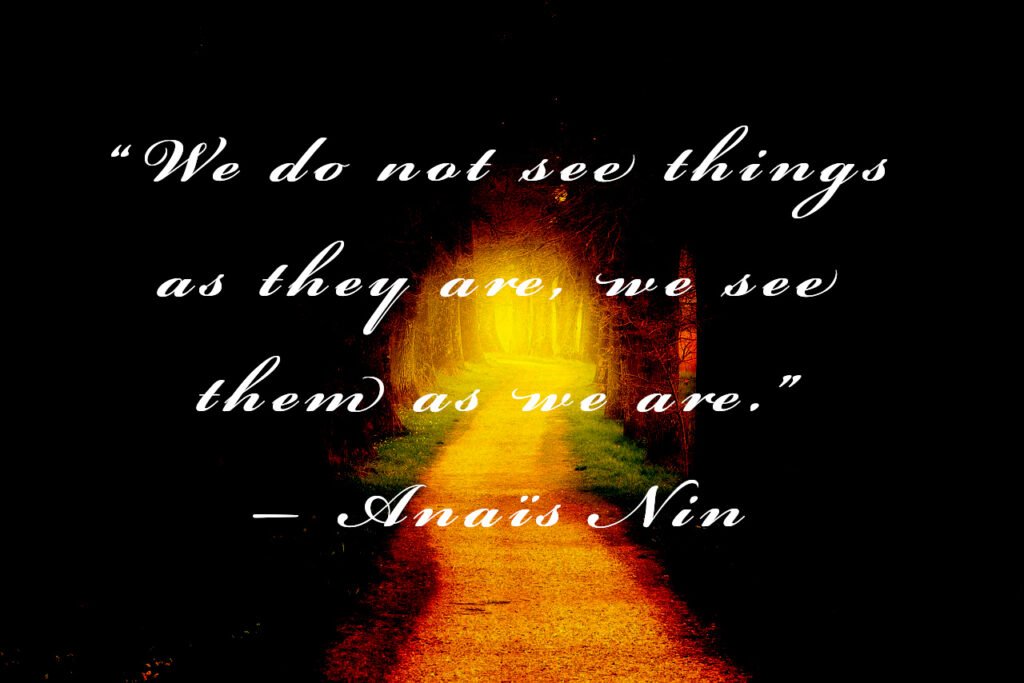
Nin’s quote is not a denial of objective truth—it is a reflection on perception. She reminds us that our experience of the world is shaped by our internal state: our wounds, beliefs, and biases. We do not look at the world from nowhere. We look from within the limits of who we are.
This is precisely why truth requires inner work. It demands we become aware of the lens through which we view reality. Not to discard truth—but to approach it with humility and discipline.
Because without that orientation, perception becomes distortion. And distortion, left unchecked, becomes delusion.
And as every metaphysician knows, a compass without a North becomes a spinning wheel in the void.

A compass is only useful if it has a fixed point of orientation—true North. Without it, it doesn’t lead you forward; it spins. It becomes a symbol of unmoored intellect, of constant motion without meaning. The same is true for human consciousness. When there is no truth—no higher principle to guide thought, speech, and action—we become reactive, circular, and ultimately lost.
The void here is not outer space—it’s inner collapse. The soul’s dislocation. A condition where all beliefs appear equal, all directions equally valid or equally meaningless. We move, but we go nowhere. We speak, but we say nothing. We become caught in a whirlpool of impressions, spinning endlessly in search of an anchor we’ve forgotten how to name.
Post-truth, my friends, post-truth has consumed our discourse.
II. The Consequences of Post-Truth
The shift from truth as a public good to truth as a private weapon has dire consequences:
- Moral Paralysis: If nothing is certain, then no cause is worth defending—and no injustice worth resisting.
- Loss of Trust: Institutions, media, and even neighbors become suspect. Without trust, society becomes a cold theatre of suspicion.
- Political Manipulation: Orwell warned us that “the past was erased, the erasure was forgotten, the lie became the truth.” In a post-truth world, power no longer needs to suppress facts—it simply drowns them.
But perhaps most concerning is the internal cost: when we no longer care whether something is true, we lose part of what makes us human.
III. The Metaphysical Implications
From a Hermetic perspective, “The All is Mind.” Reality is a mental projection; perception shapes experience. But there’s a crucial distinction: while perception informs our experience of truth, it does not create truth itself. This is the Principle of Correspondence at play—there is harmony between the mental (above) and the material (below), but they must be aligned through consciousness, not confusion.
Epistemological collapse distorts this alignment. It replaces resonance with dissonance. As the Principle of Polarity teaches, truth and falsehood are not separate things—they are degrees of the same continuum. But when our internal calibration is broken, we lose the ability to discern where we are on that scale.
Thus, post-truth is not a mere social condition. It is a metaphysical disorder: a disintegration of the bridge between the knower and the known.
IV. The Silence That Betrays
Amiel’s insight is piercing: truth may be equally outraged by silence. Lies are loud, but apathy is deadly. The subtle normalization of distortion is often more destructive than overt falsehood. It creeps in unnoticed—through resignation, distraction, or fatigue.
“The most dangerous time for the truth is not when it is shouted down, but when no one bothers to speak it.”
This silence is not neutral. It is a quiet betrayal of conscience, a collective turning away from what must be faced.
V. Why This Matters Now
The epistemological breakdown is not a niche concern for philosophers. It strikes at the core of how we relate to one another, how we govern ourselves, how we educate our children, and how we envision the future.
“The salvation of this human world lies nowhere else than in the human heart, in the human power to reflect, in human meekness and human responsibility.”
— Václav Havel

In other words: truth begins within. It is not something imposed from outside, but something cultivated inwardly, then lived outwardly with courage.
VI. A New Integrity of Knowing
To recover truth is not merely to compile better facts, but to renew a culture of epistemic integrity—a way of being that honors truth as sacred, even when it is inconvenient or unsettling.
This begins with:
- Critical Thinking: Asking not just what is being said, but why, by whom, and to what end.
- Moral Courage: Choosing clarity over comfort, even when the truth offends.
- Inner Reflection: Holding a mirror to our own beliefs and biases with honesty and humility.
“The ideal subject of totalitarian rule is not the convinced Nazi or Communist, but people for whom the distinction between fact and fiction… no longer exists.”
— Hannah Arendt
This statement was not a historical observation alone—it was a warning. We ignore it at our peril.
VII. A Quiet Revolution
In the face of cultural disorientation, to choose truth is an act of rebellion. But it is not a rebellion of noise or violence. It is a quiet revolution of discernment, conscience, and courage.
To care about truth in a world that profits from its distortion is an act of integrity.
To speak truth, even when it’s unpopular, is an act of love.
To live truthfully—consistently, compassionately, courageously—is an act of hope.
And it is this kind of hope we need most right now.
Causes of the Collapse
Information Overload & Noise Saturation
- Inundated by data, our nervous systems adapt by filtering meaning through familiarity, not veracity. What feels right is accepted; what challenges is rejected.
Digital Echo Chambers
- Social media algorithms feed our biases. We mistake the mirror for the window, and gradually, we see only ourselves reflected back—never the world as it is.
Moral Relativism
- Without shared metaphysical axioms, values become preference. Truth becomes narrative. This undermines both ethics and reason, the twin pillars of civilization.
Distrust in Institutions
- Corruption and deception have made skepticism healthy—but when taken too far, it turns into cynicism, where nothing is trustworthy and everything is suspect.
The Esoteric Response: Reclaiming the Inner Light
The answer is not to impose a singular “correct” truth upon the world—but to initiate a renaissance of epistemic virtue and inner clarity. In metaphysical terms, this is the restoration of harmony between Mind (Thought), Heart (Emotion), and Will (Action)—the internal Trinity.
We must become again what the Mystery Traditions have always pointed to: Living Gnostics. Not gnostics in dogma, but in discipline—committed to the direct apprehension of truth through sincerity, reason, intuition, and sacred curiosity.
This requires:
- Mental Sovereignty: Learning how to think, not what to think.
- Moral Courage: Standing firm in truth even when it is unpopular.
- Spiritual Alignment: Tuning oneself to Natural Law, not manmade noise.
The Call to the Great Work
The epistemological breakdown is not the end of an age—it is the beginning of an initiation. The illusions are collapsing, yes—but that is the necessary precondition for revelation.
The Hermetic path does not fear destruction, for it knows that in the alchemical fire, the dross is burned away and only the gold remains. As seekers of wisdom and guardians of meaning, we are called not to mourn the old world, but to midwife the new.
The Great Work now is to re-enchant the world with truth—not imposed from without, but revealed from within.
Final Thought
“We do not see things as they are, we see them as we are.”
— Anaïs Nin
So let us become people who are capable of seeing clearly again—not because truth has become easy, but because we have become strong enough to hold it.
Let us restore truth not only as a principle but as a presence—in our conversations, our relationships, and our lives.
The world will not be healed by more opinions.
But perhaps—just perhaps—it can begin to heal through a deeper fidelity to what is real.